
Advances in nanotechnology have driven innovative applications in health, the environment, and industry. However, one of the main challenges associated with the use of nanomaterials is ensuring their biological and environmental safety, especially given their potential to induce toxic effects in living organisms. In this context, a recent study published in the journal Environmental Science: Nano investigated how the structural modification of nanoparticles can directly influence their biocompatibility and functionality.
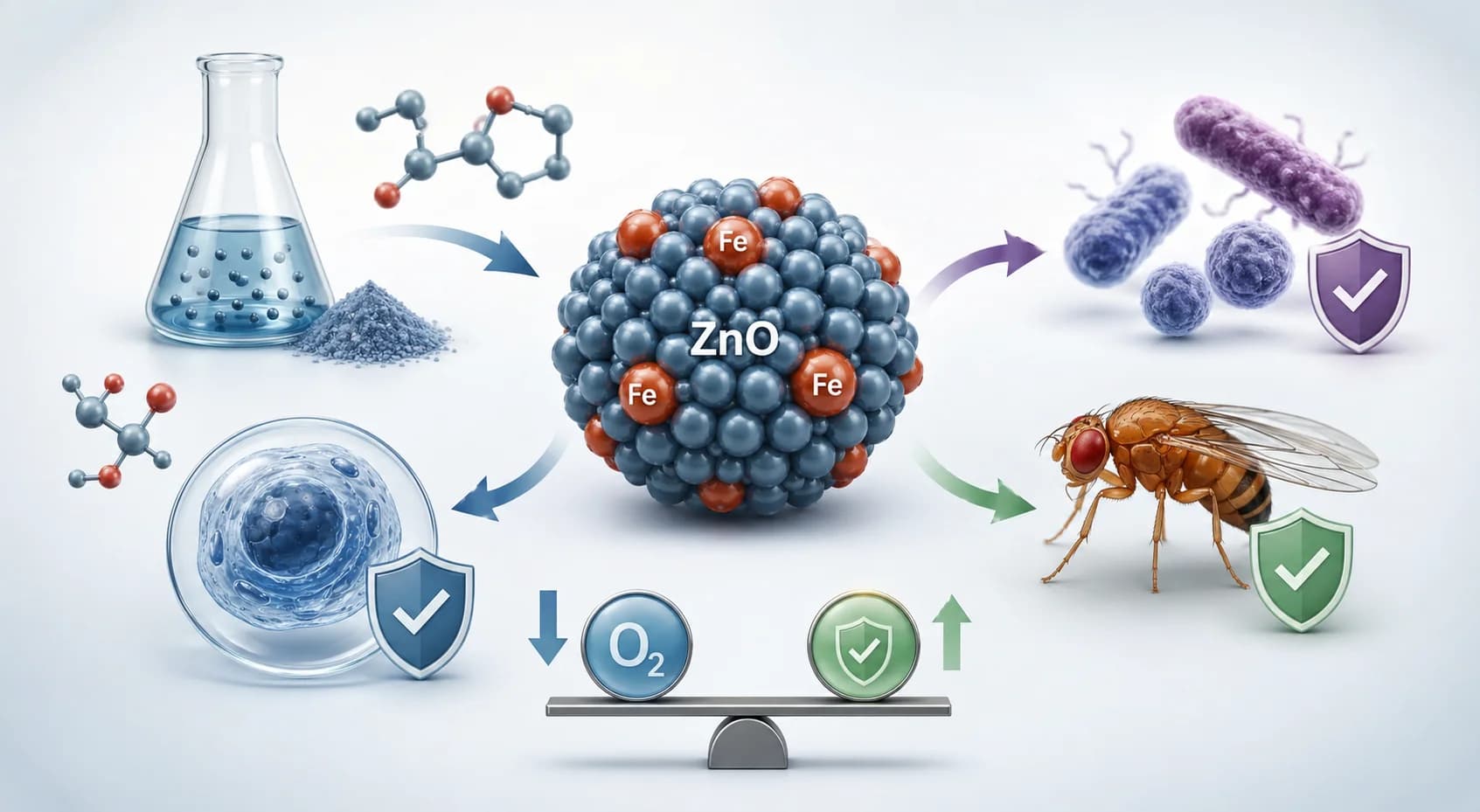
The research evaluated iron-doped zinc oxide nanocomposites (Fe–ZnO/Fe₂O₃), analyzing how different iron concentrations impact structural, biological, and functional properties. Zinc oxide is widely used for its antimicrobial activity and photocatalytic capacity, but these same characteristics are often associated with high production of reactive oxygen species (ROS), which can result in cytotoxicity and adverse environmental effects.
The results showed that incorporating iron allows these properties to be strategically modulated. At adequate doping levels, there was a significant reduction in ROS generation, increased cell viability, and decreased cytotoxicity compared to pure ZnO. In vitro assays with macrophages indicated greater biocompatibility, while in vivo analyses using Drosophila melanogaster showed higher survival rates and less intestinal damage, reinforcing the safety of the nanocomposites in complex biological systems.
Beyond the improved toxicological profile, the iron-doped nanomaterials maintained strong antimicrobial activity against relevant pathogens such as Staphylococcus aureus and Pseudomonas aeruginosa. Additionally, anti-glycation activity was observed, indicating potential application in conditions associated with the accumulation of advanced glycation end products (AGEs), such as diabetes and neurodegenerative diseases.
Another relevant aspect of the study is the demonstration that properties such as photocatalytic efficiency, biological activity, and safety can be adjusted in a controlled way through materials engineering. Although increasing the iron concentration reduces photocatalytic efficiency due to electron-hole recombination, it drives important gains in biocompatibility and biological functionality, highlighting the need to balance performance and safety in the development of nanomaterials.
From an environmental and technological standpoint, the results indicate that it is possible to develop multifunctional materials with lower ecological impact, broadening their applications in environmental remediation, water purification, antimicrobial systems, and biomedical platforms. More than that, the study contributes to a paradigm shift in toxicology, demonstrating that safety can be built into a material's design from the start, rather than only assessed afterward.
This approach is directly aligned with NexusBioTox's mission, which operates at the interface of biotechnology, toxicology, and industrial innovation. By using alternative models and molecular biomarkers, the company contributes to generating faster, more predictive, and ethically sustainable data, supporting the safe development of new materials and products.
In this way, the development of nanocomposites such as Fe–ZnO/Fe₂O₃ represents a significant advance in building safer, more efficient technologies, consolidating a new scenario in which innovation and biosafety move forward together.